Léopold

The terrain

From the sea to the Piton: thirty kilometres, three worlds.

From the sea to the summit of the volcano is thirty kilometres. In a single morning’s walk you go from a dry forest to a lava desert where almost nothing grows — and between the two, relics of primary forest. Each belt has its own species. Many exist nowhere else in the world. Some can be counted on one hand. What I teach you is how to read that scale.

Réunion, the marvellous island with more than a hundred microclimates…

What relief & the trade winds shape

Office national des forêts, Réunion regional directorate.

Species that exist nowhere else

An endemic species exists on this territory and nowhere else. A young volcanic island isolated in the Indian Ocean produces many of them — and loses them fast. The Tuit-tuit, a bird of La Roche Écrite, is among the most threatened passerines in the world. Knowing that changes the way you walk.

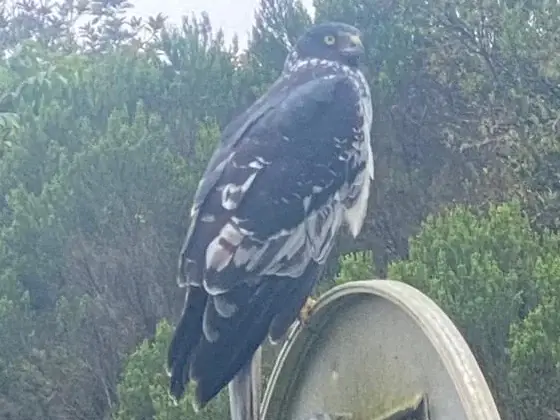
An adult Réunion harrier perched on a road mirror, in front of a thicket of shrubs.
PapangueCircus maillardi

Belt one
0 – 1,000 m · 17.5 to 24 °C

The low and mid-altitude environments
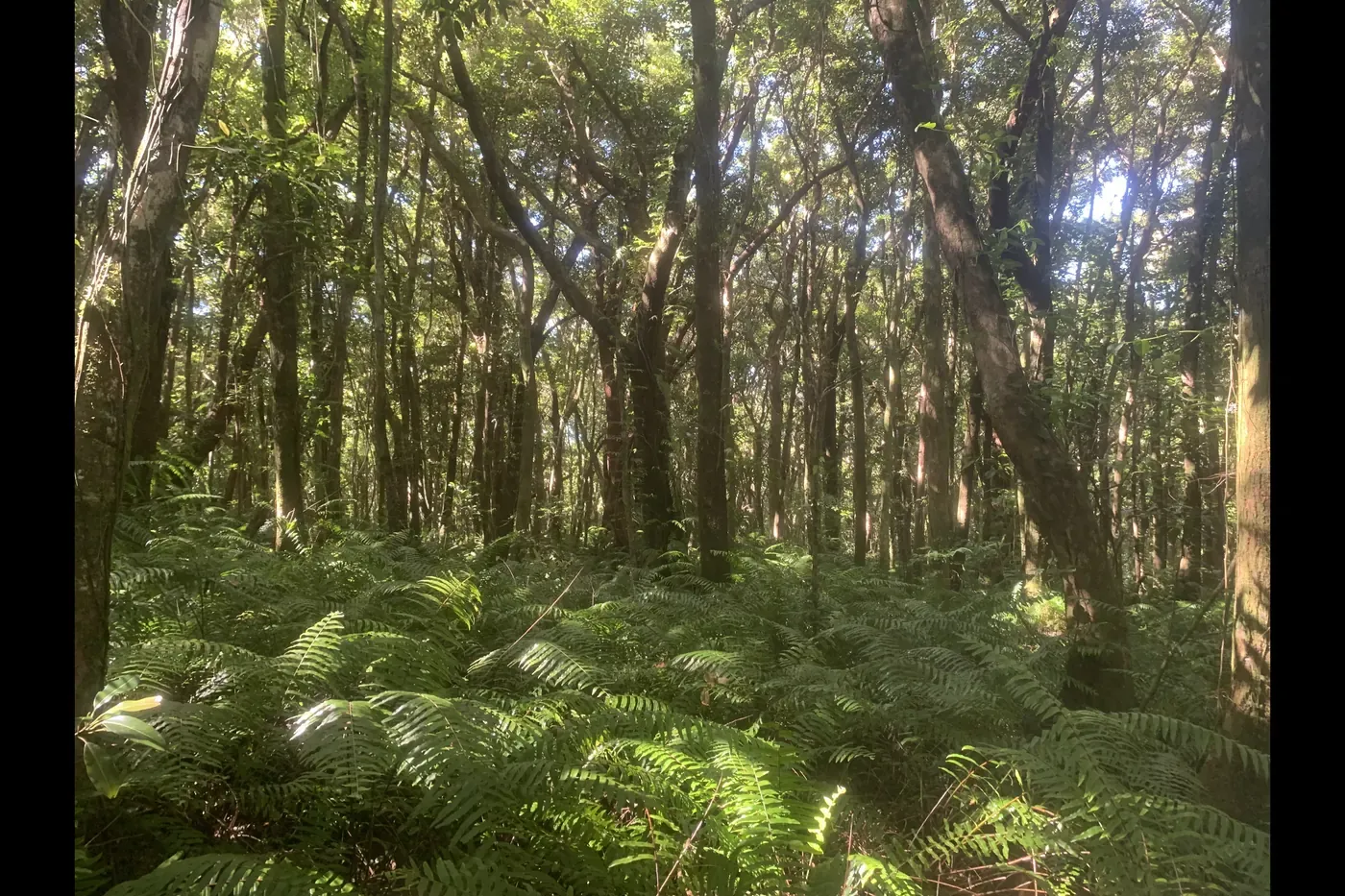
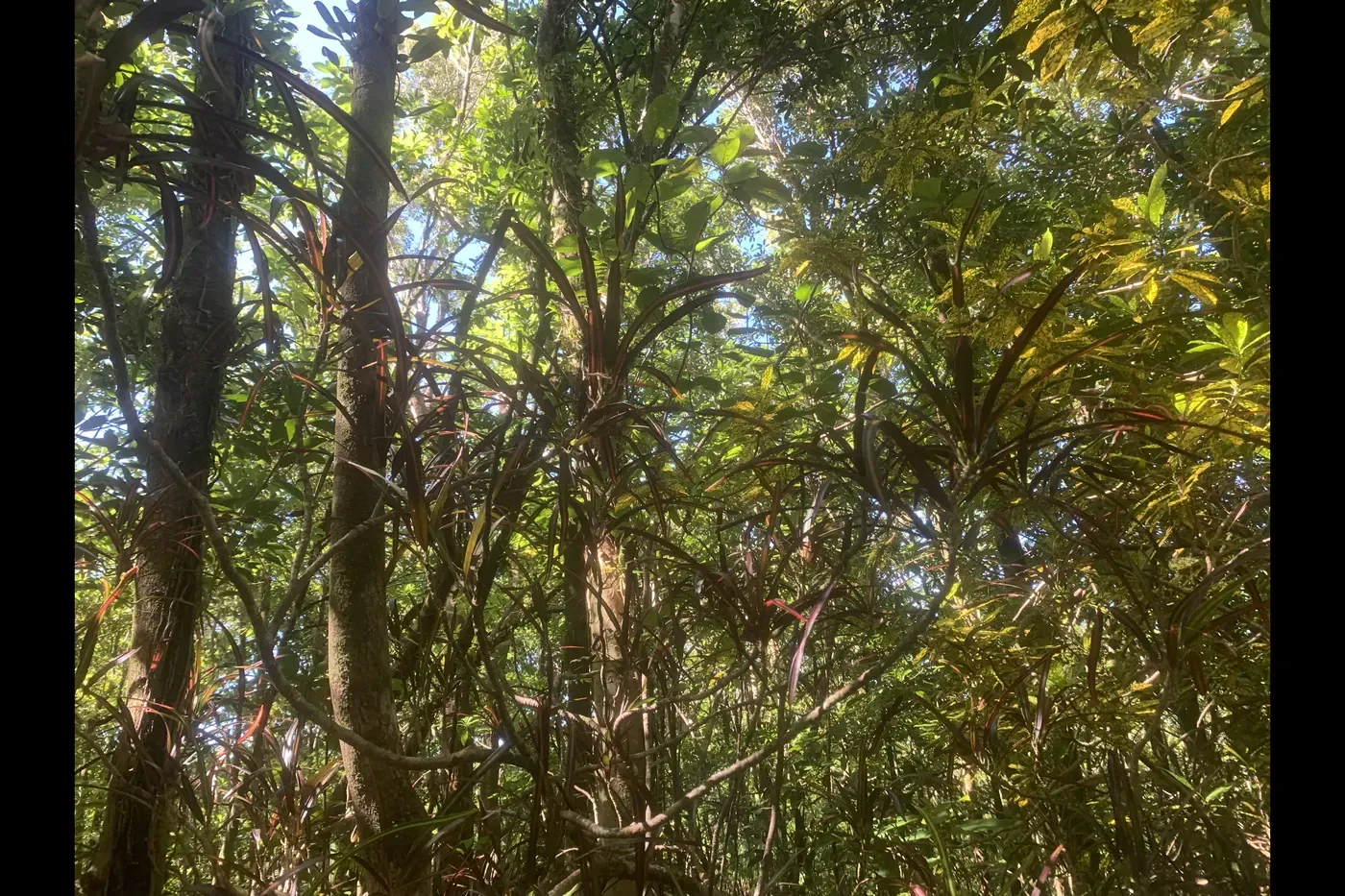
Inside a humid forest: slender crowded trunks, light coming through the canopy, a thick carpet of ferns on the ground.
Dense low-altitude forest thicket: leaning tangled trunks, large fan-like compound leaves, patches of sky between the crowns.

At this altitude the same band carries two forests with nothing in common. To the west, in the lee, the semi-dry forest: few epiphytes, ground that burns fast, and trees some of which can still be counted on one hand. To the south-east, into the wind, the bois de couleur des bas forest: tall trees, a carpet of ferns up to your knees, epiphytes on every branch. What separates them is not altitude, it is rain.
→ Planning a Mafate crossing

Belt two
1,000 – 2,000 m · 11 to 17 °C

The mountain environments

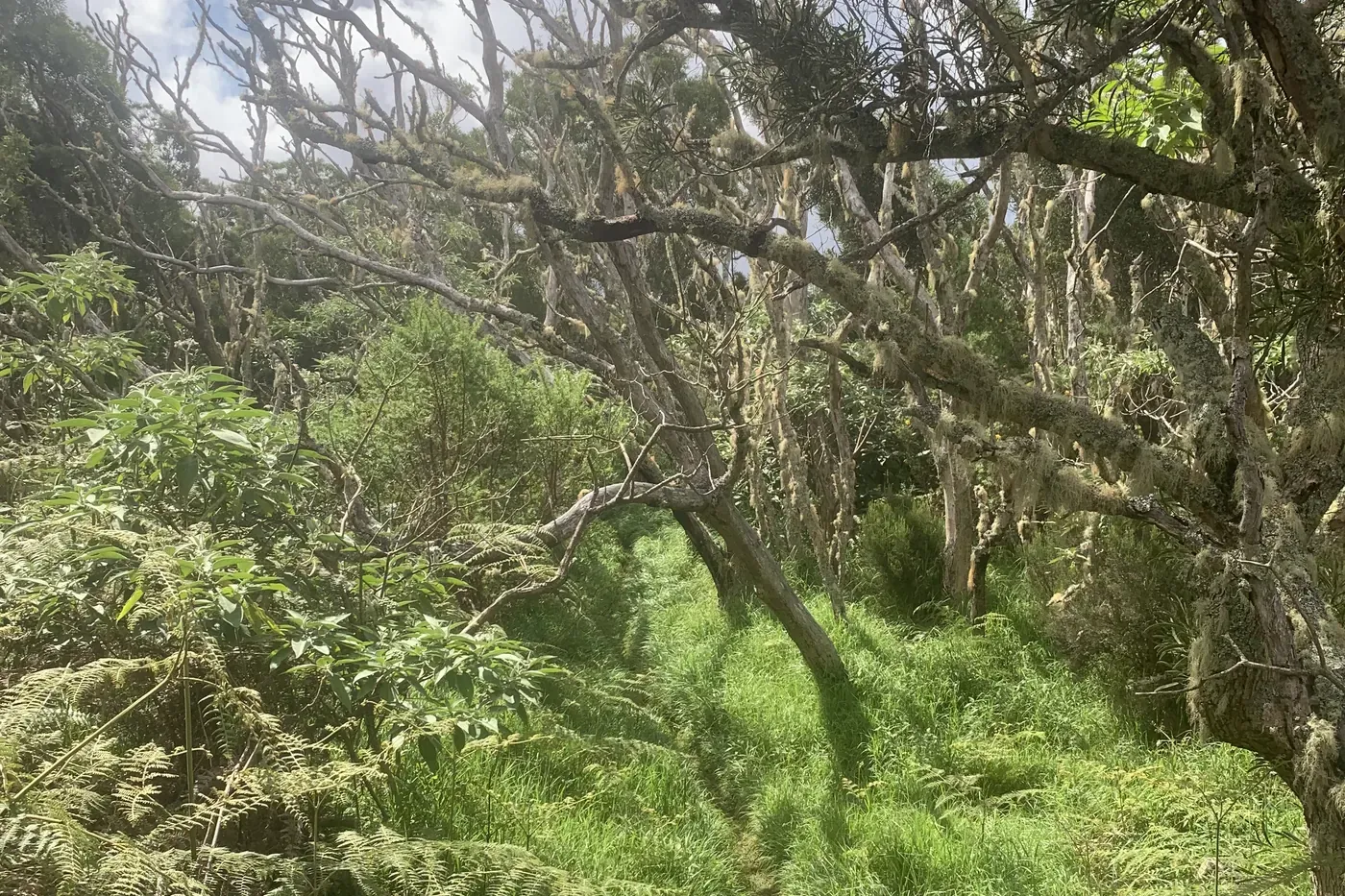
A narrow path through a forest of mountain acacias, twisted branches hung with beard lichen above a carpet of fine grass.
Mountain acacias (tamarins des Hauts).
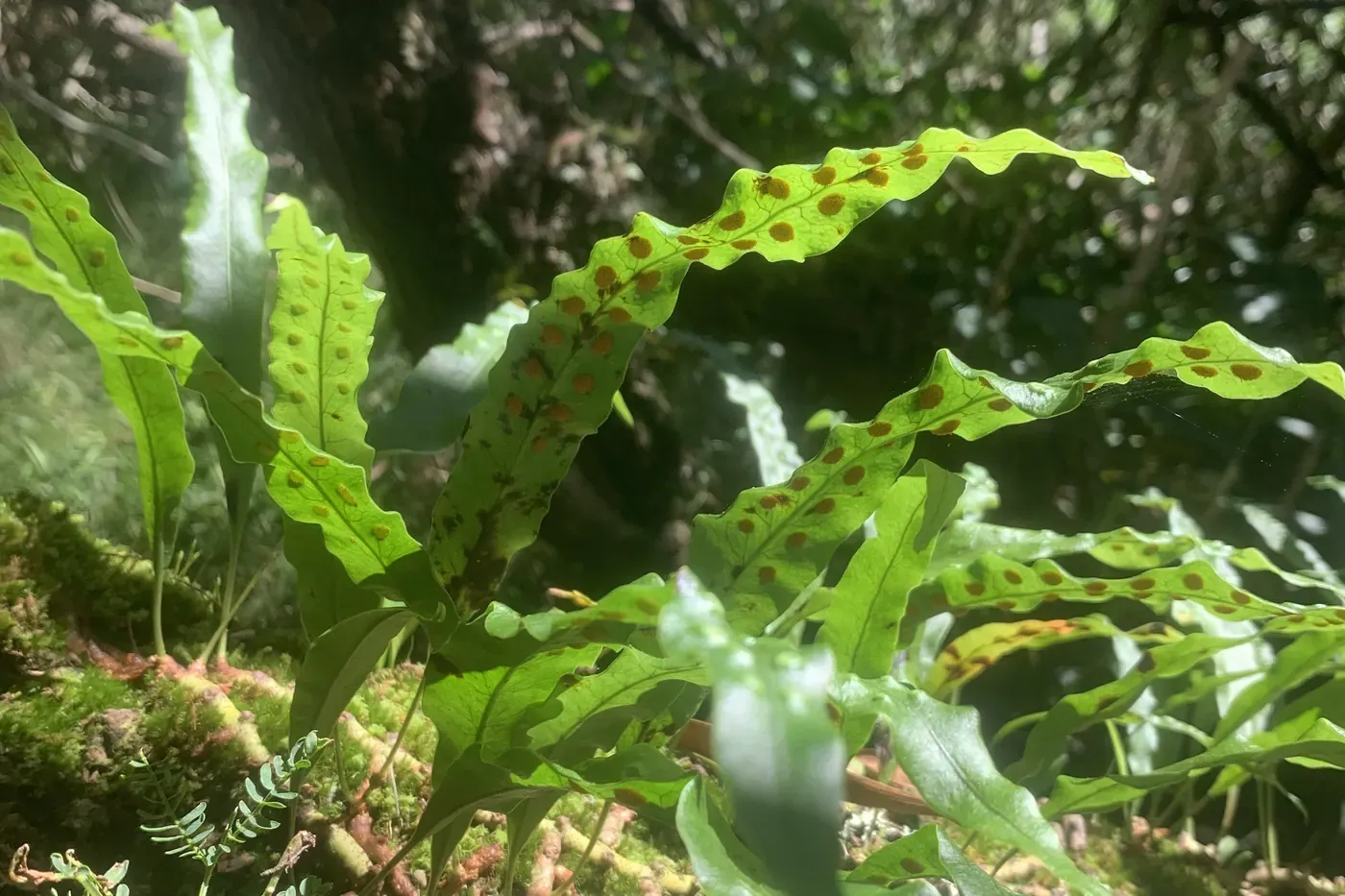
Fern fronds with long, wavy pale-green leaves marked by rows of round rusty spore patches, growing on a moss-covered trunk in sunlit undergrowth.
Ti lentilles fern Lepisorus excavatus

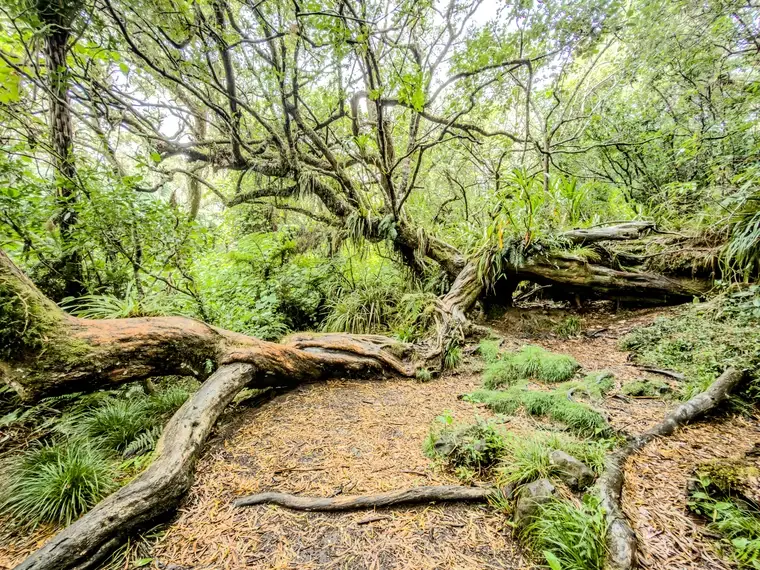
The Bébour-Bélouve forests still shelter relics of primary forest, within a massif where some plots are also managed for silviculture, notably of the mountain acacia. Tree ferns rise to head height, mountain acacias twist above the path, and the humidity builds a world of mosses seen nowhere else. It is where you meet the most species in a single day.

A mountain acacia with twisted, moss-covered branches arching over a litter-strewn path, mossy trunks and roots on either side, tufts of grass and ferns on the banks.
Mountain acaciaAcacia heterophylla
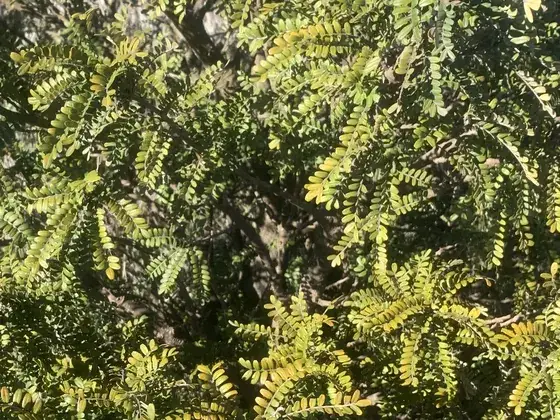
Dense foliage of a petit tamarin des hauts: shoots bearing long leaves made of many small leaflets, pale green where the sun strikes them.
Petit tamarin des hautsSophora denudata
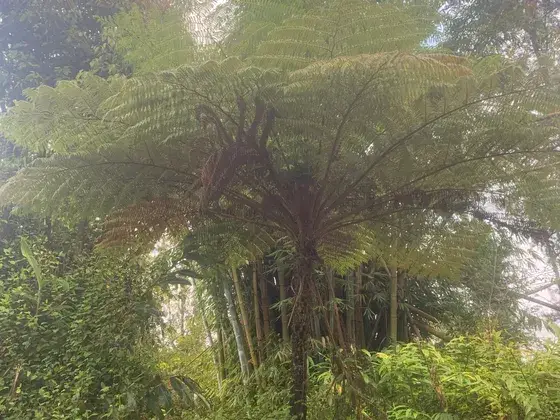
A tree fern at a forest edge: a crown of large, finely divided fronds atop a dark trunk, a skirt of old brown fronds beneath the crown, bamboo behind it.
Tree fern (fanjan)Cyathea sp.
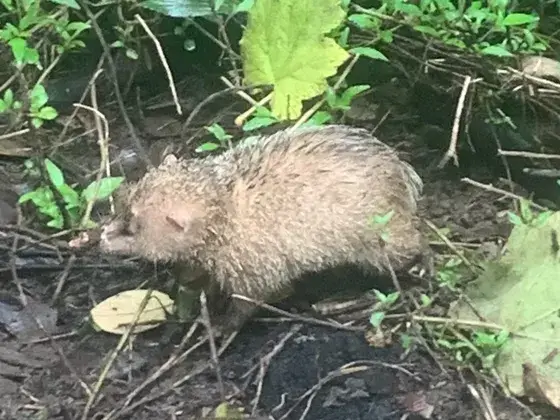
A tenrec in profile on a floor of dead leaves, pointed snout and bristly light-brown coat, at the foot of a thicket.
Tenrec (tangue)Tenrec ecaudatusintroduced from Madagascar
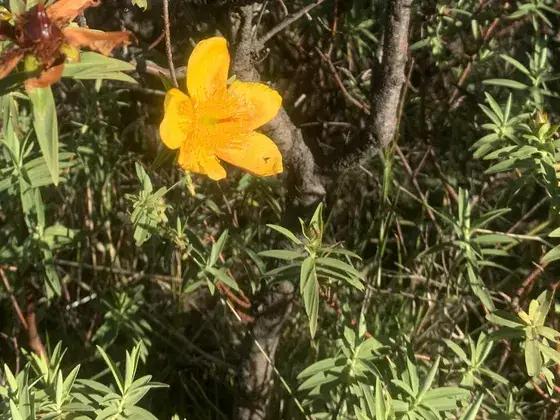
An open five-petalled yellow flower, a rusty spent flower beside it, among shoots with narrow lanceolate leaves.
Fleur jauneHypericum lanceolatum

→ The Trou de Fer hike

Belt three
above 2,000 m · 11 to 5 °C

The high-altitude environments

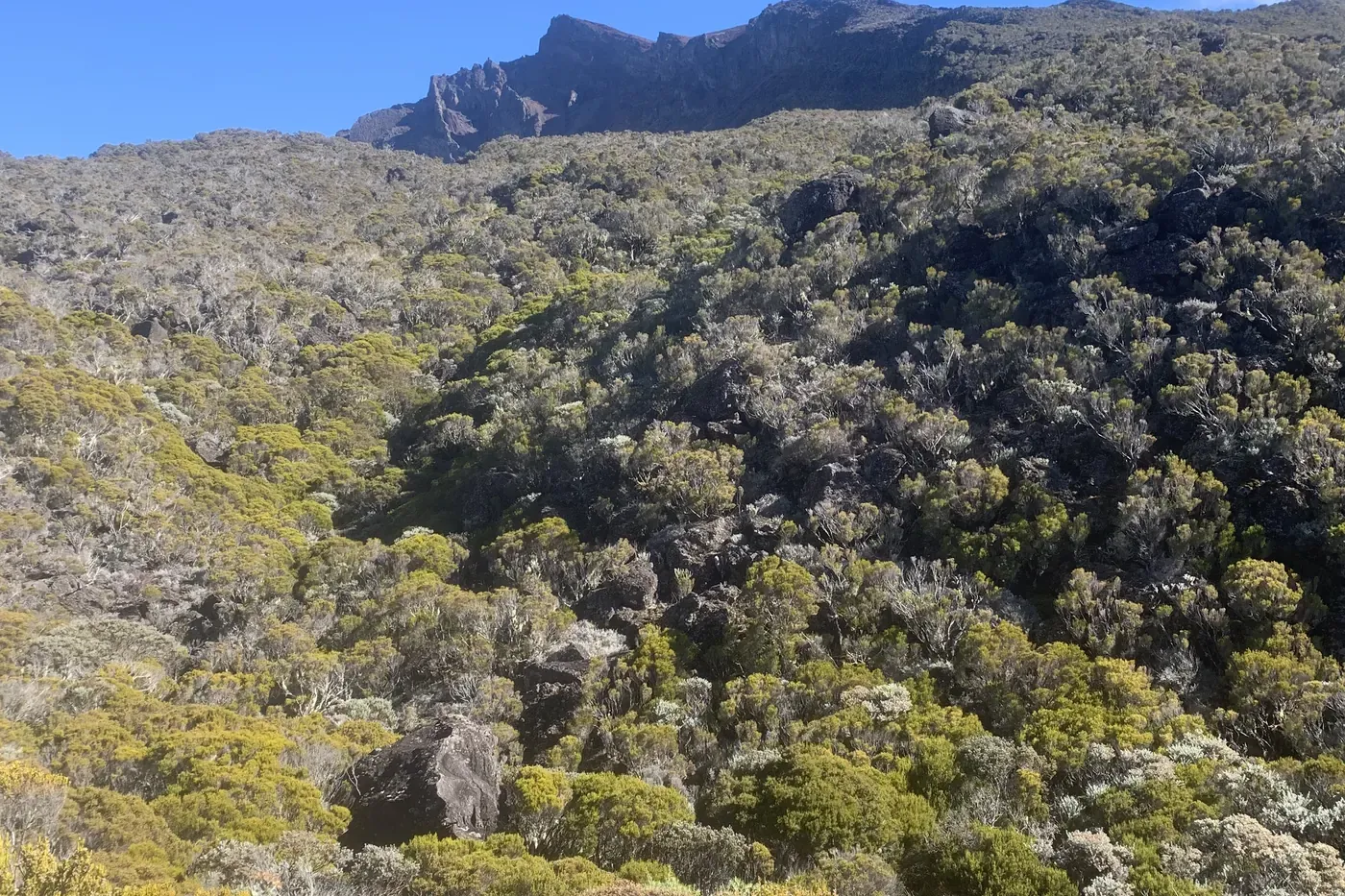
Heath scrub in yellow and grey-green cushions across a slope, a rocky ridge behind it under a blue sky.
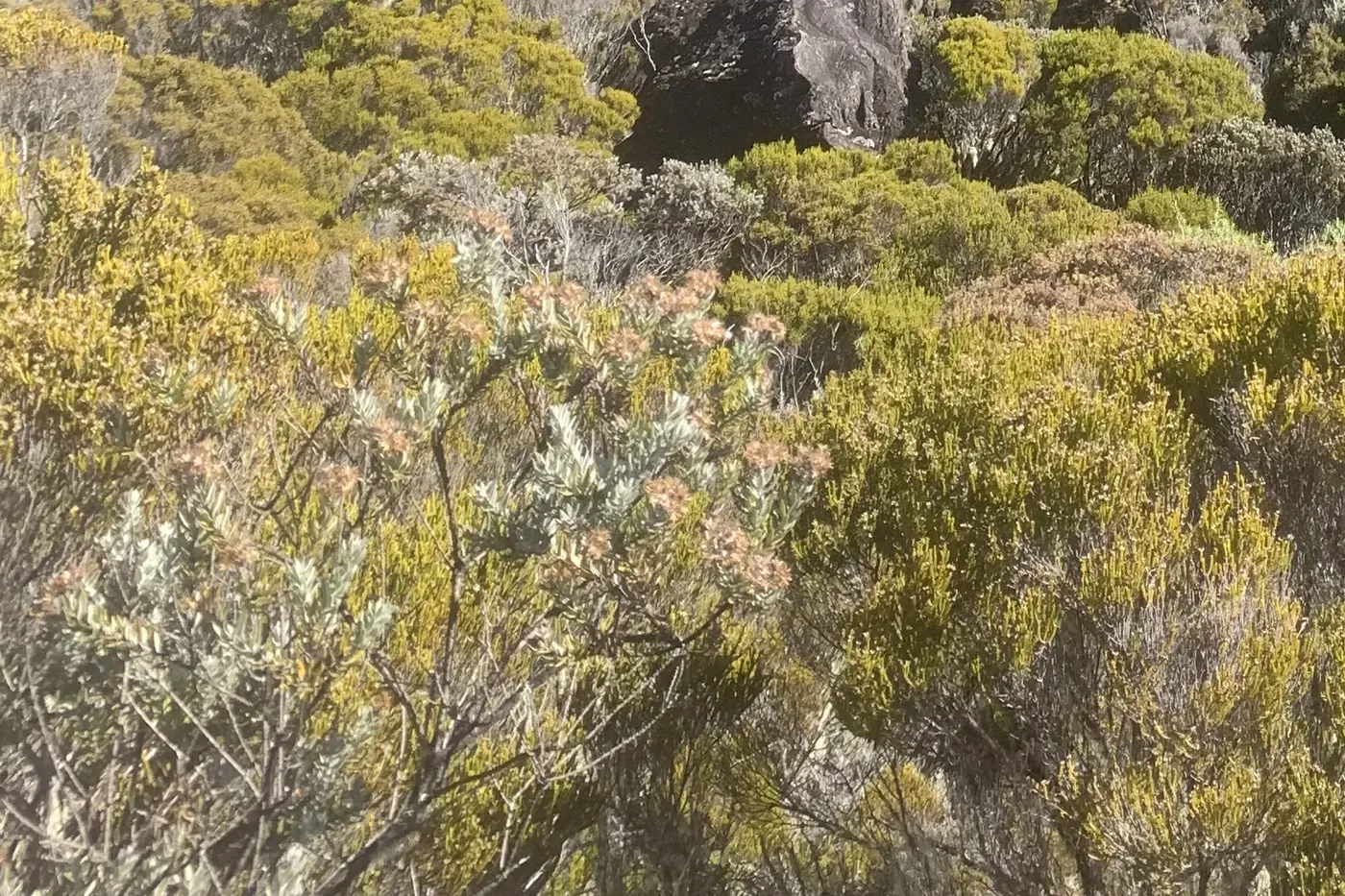
Heath scrub on a slope: dense yellow-green and grey-green bushes, a dark lava block in the middle, a shrub with grey leaves and rusty flowerheads in the foreground.

Ericoid thicket

Piton de la Fournaise is one of the most active volcanoes on Earth, and one of the few where you walk on lava flows younger than you are. It is where you read the colonisation of bare ground: nothing at first, then lichens, then the first pioneer plants taking hold in the rock.

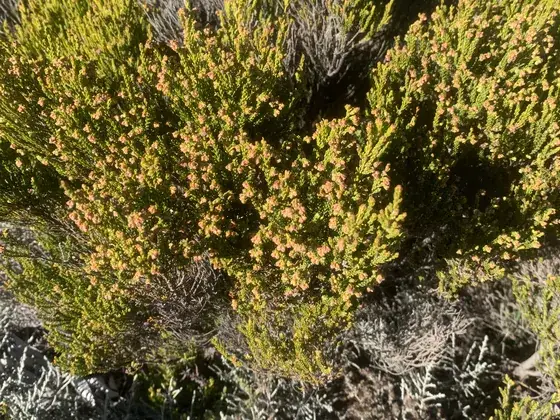
Close view of a branle vert bush: upright shoots in tight scales, covered with small salmon-coloured buds, a silver-grey shrub behind it.
Branle vertErica reunionensis
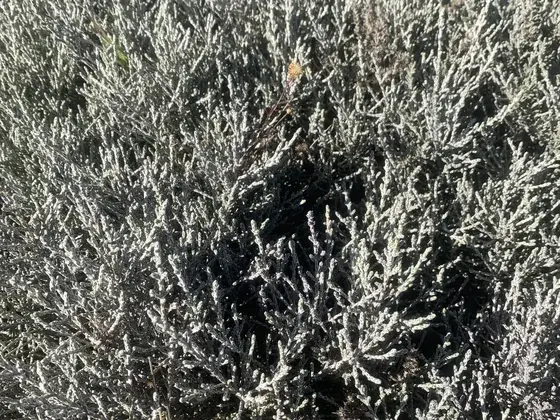
Close view of a branle blanc bush: slender shoots felted all over in silver-grey, a dry flower stalk at the centre.
Branle blancStoebe passerinoides
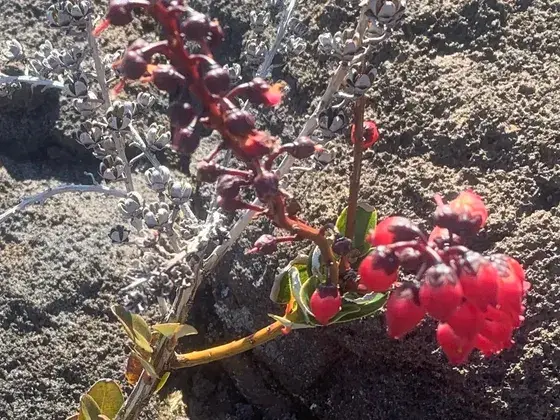
Petit bois de rempart growing between lava boulders: clusters of red bell-shaped flowers, small oval green leaves, a silver-grey shrub tangled among its stems.
Petit bois de rempartAgarista buxifolia
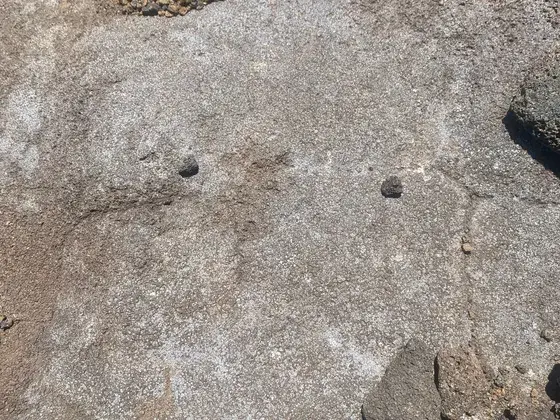
A slab of lava seen from above, speckled with small whitish-grey lichen granules, scoria blocks around the edges.
Lichen du volcanStereocaulon vulcani

→ The Piton de la Fournaise hike